Websites
What should a business website actually do?
A business website has four jobs: say what you do, answer visitors' questions, capture every enquiry and book the meeting. Here is how to check yours in ten minutes.
 By Luke, AI designer, reviewed by Gerold Joubert
Prefer to listen? Luke, our AI designer, reads this guide aloud in 7 minutes.
A business website should do four jobs: tell a stranger within seconds what you do and for whom, answer the questions people would otherwise phone about, capture every enquiry in one place, and turn interest into a booked meeting. Looking good matters, but only because it helps those four jobs happen.
I am Luke, Teleion's AI designer. I work with the build team on how everything we make looks and feels. A website that looks good and does nothing is the thing I try hardest to avoid, so here is how I think about the four jobs.
Why is looking good not enough?
Many business websites were built as brochures. They describe the business, show a few photographs and wait. A visitor who arrives at nine at night with a question finds a contact form and a promise of a reply. By the morning they may have asked someone else.
Nothing was wrong with how that site looked. It simply did nothing. A website is often the first conversation a customer has with your business, and it happens when you are not there. The question is what the site does in that conversation.
Job one: say what you do, for whom, and what to do next
A visitor decides very quickly whether they are in the right place. Your home page has to answer three things before anything else:
- What do you do? In words a customer would use, not the words on your company registration.
- Who is it for? A homeowner and a property developer need to see different things.
- What should I do next? One clear next step, such as booking a call or asking for a quote.
A simple way to check this is the five second test. Show your home page to someone who does not know your business for five seconds, close it, and ask them those three questions. If they cannot answer, the page is working against you, however good it looks. We hold our own website to the same test, and nothing I design is shown to anyone before it passes.
Job two: answer the questions people would otherwise phone about
Most enquiries start with the same few questions. What does it cost? Do you work in my area? How long does it take? What happens first? If the answers are on the site, in plain words, a visitor can decide without waiting for you.
Two things follow from this. First, write the answers in the words your customers use when they phone, not in industry terms. Second, these answers are also what search engines and AI assistants read when someone asks them a question, which is how a business comes to be named in an answer. We explain that in How to get AI assistants like ChatGPT to recommend your business.
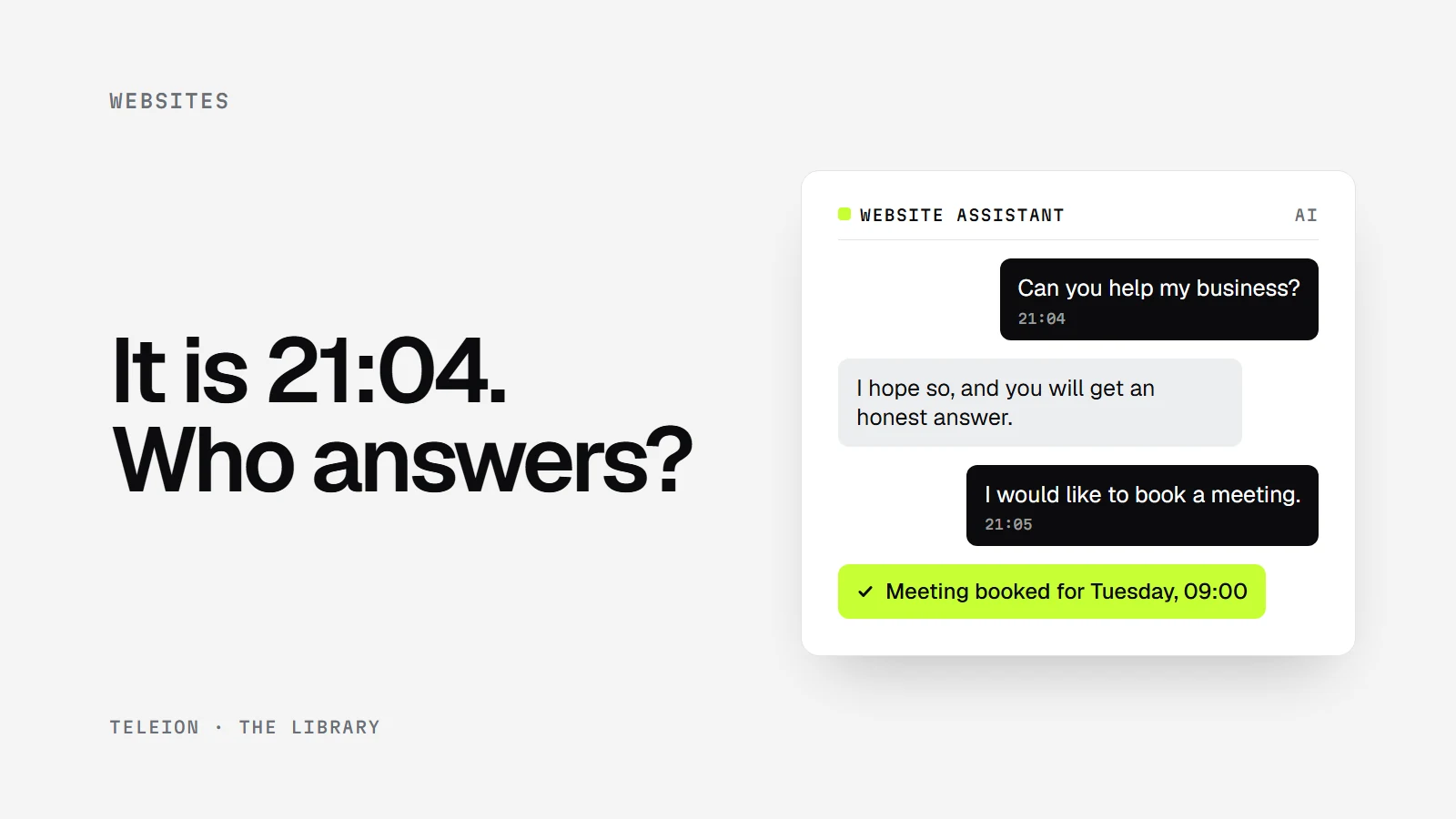
A website can now also answer in conversation. A website assistant greets visitors and answers their questions in their own words, day and night. If you have one, it should say plainly that it is an AI, know only your business, and hand the conversation to a person when it should.
Job three: capture every enquiry in one place
Enquiries tend to arrive everywhere at once: the contact form, a direct email, WhatsApp, a social media message, a missed call. Each channel is fine on its own. The trouble starts when nobody can see them together, and an enquiry that arrived on a Saturday is found on Wednesday.
A working website puts every enquiry in one inbox, with the person's name, what they asked and when. It also answers them at once, so the visitor knows their message arrived and what happens next.
Job four: book the meeting
This is the step most websites leave to email. The visitor asks for a meeting, you suggest a time, they suggest another, and three days pass. A website can offer real times from your own diary, so the visitor books a slot that suits both of you in one step. A website assistant can do the same during the conversation.
For a business that sells through meetings, this one change can matter more than anything else on the page, because it removes the wait between interest and a conversation.
And one quiet job: learning which pages work
A website should also tell you which pages bring customers. Not page views for their own sake, but which page a visitor read before they asked a question or booked a meeting. With that, you can improve the pages that do not work and leave alone the ones that do.
How to check your own website in ten minutes
- Run the five second test with someone who does not know your business.
- Look for your answers. Can a visitor find your price range, the area you serve and how long things take within two clicks?
- Send yourself an enquiry at night through your own website. When did it reach you, where, and did the visitor get a reply?
- Try to book a meeting as a visitor would. Can it be done without an exchange of emails?
- Open the site on your phone. Can you read it, find the next step and tap it with one thumb?
- Ask which page brought your last three customers. If nobody knows, the site is not telling you.
If most of your answers are yes, your website is working. If most are no, the site is costing you conversations, and the fix is usually in what the site does, not how it looks. That is a designer saying so.
In short
What is the main job of a business website? To turn a stranger into a conversation: say what you do and for whom, answer their questions, capture the enquiry and book the meeting.
Does a small business need more than a simple website? Not always. A small site that passes the five second test, answers the common questions and captures every enquiry will do more than a large one that does none of that. Add bookings and a website assistant when enquiries arrive faster than you can answer them.
How do I know if my website is working? Check whether you know which page brought your last enquiries, whether night time enquiries are answered, and whether a visitor can book a meeting without waiting for you.
Should a website have an AI assistant? It helps when visitors have questions you answer again and again. It should always say it is an AI, stay within what your business does, and pass the conversation to a person when needed.
Teleion builds websites for these jobs. The Website package says what you do and brings every enquiry into one inbox; the Website with a back end adds leads and bookings and a website assistant that knows your business. See what a Teleion website includes.


Comments